
Your Sunday morning production shouldn’t feel like a high-stress tightrope walk. You want a broadcast that looks professional, captures every moment of the message, and engages your online audience. But here is the reality: finding enough skilled volunteers to man every camera, every single week, is a battle.
Exhaustion sets in. Mistakes happen. Maybe a camera operator misses a cue, or worse, you simply don’t have enough hands to cover the stage.
This is where technology meets ministry. At Shepherd Multimedia Inc., we have spent over 21 years helping churches and organizations bridge the gap between high-end production and volunteer-friendly operation. The answer isn’t just “more gear.” It is smarter gear. By integrating AI auto-tracking cameras into your existing system, you can elevate your livestream from “basic” to “broadcast-quality” without adding a single person to your rotation.
The Power of the Hybrid Setup: Why One Type of Camera Isn’t Enough
The most common mistake we see is the “all-or-nothing” approach. Some venues try to go 100% manual, which burns out volunteers. Others try to go 100% robotic, which can feel cold and clinical.
The “Sweet Spot” is a hybrid multi-camera system.
To create a dynamic livestream, you need variety. You need a mix of wide shots, tight shots, and movement. Here is how we recommend structuring your camera layout:
- The Safety Shot (Static Wide): A fixed camera that captures the entire stage. This is your “home base.” If something goes wrong elsewhere, you switch to this shot.
- The Hero Shot (AI Auto-Tracking PTZ): This is your workhorse. It follows the pastor or speaker across the stage automatically. No human intervention required.
- The Detail Shot (Standard PTZ): A standard Pan-Tilt-Zoom camera used for close-ups on the worship leader, the pianist, or specific stage elements. A volunteer can control this from a joystick, focusing on one thing at a time.
Understanding AI Auto-Tracking: It’s More Than Just Motion
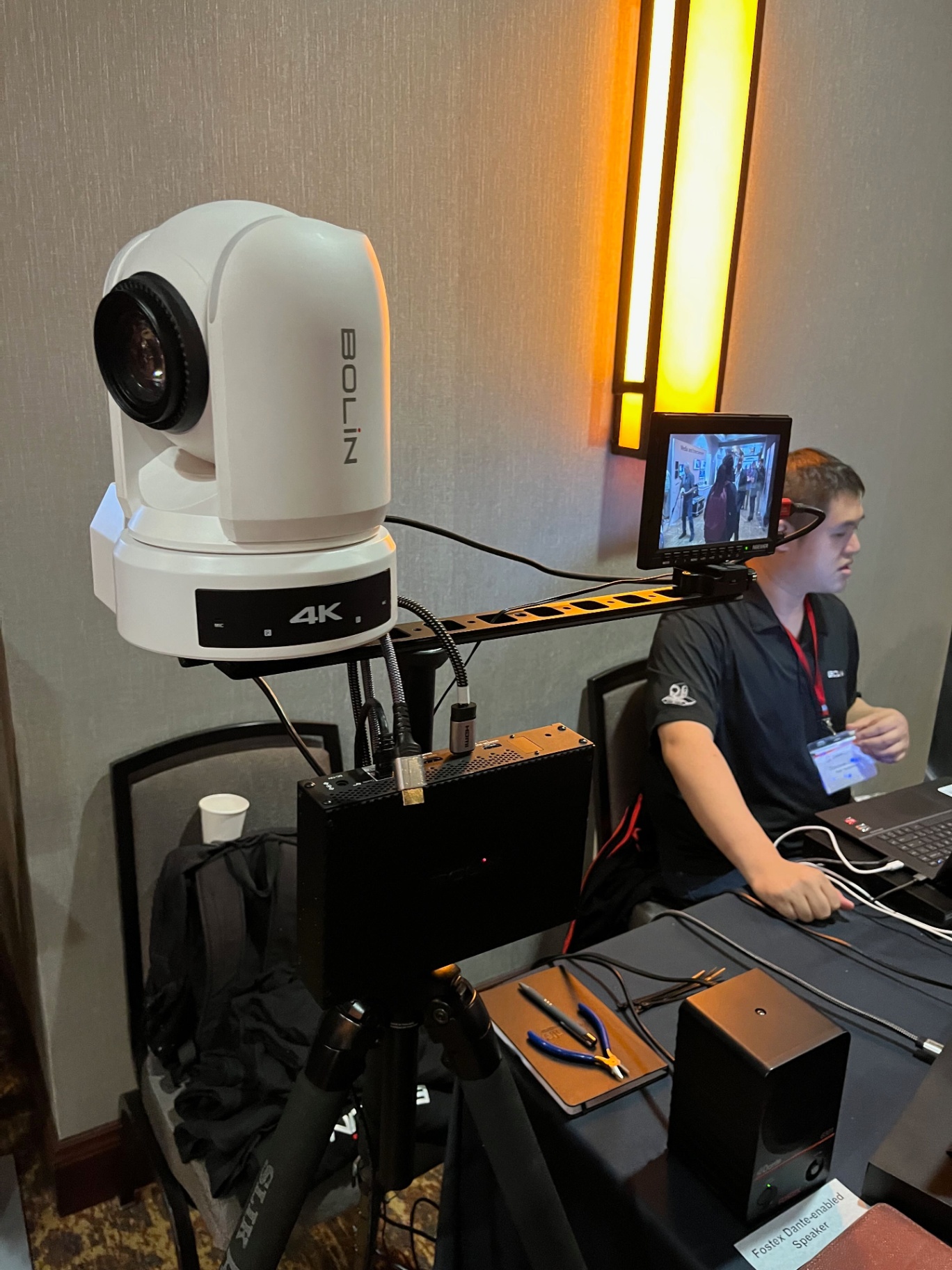
In the past, “auto-tracking” was hit or miss. If a bird flew by or someone walked behind the speaker, the camera would lose its mind. Modern AI tracking is different. It uses facial recognition and body-shape analysis to “lock on” to a specific subject.
When we integrate these systems for our clients, we focus on the Internal Intelligence of the camera. Modern AI PTZ cameras handle the processing internally. They don’t need an external computer or a specialized server to tell them where to look. They see the speaker, they identify them as the priority, and they follow smoothly.
For your volunteers, this is a game-changer. Instead of worrying about keeping a moving target in the center of the frame, they can focus on the “story” of the service: switching shots, monitoring audio, and ensuring the livestream is reaching the audience.
The Technical Foundation: Setting Up for Success
You can’t just plug in an AI camera and hope for the best. To make this work for a volunteer-run team, the initial configuration must be rock-solid. Here is how we handle the technical integration:
1. Power and Connectivity (PoE+)
We utilize Power over Ethernet (PoE+). This means one single cable provides power, data, and video signal to the camera. It simplifies the installation and reduces the “clutter” in your sanctuary or auditorium.
2. Defining Motion Zones
One of the most critical steps is defining the camera’s “operational boundaries.” You don’t want the camera following the pastor into the front row of the pews or tracking a distraction in the wings. We configure “motion detection zones” through the camera’s web interface. This tells the AI, “Only look for subjects within this specific frame on the stage.”
3. Setting Presets and Reference Points
Even with AI, you need manual backups. We set “Presets”: pre-programmed positions the camera can snap to with the press of a button. If the AI gets confused (which can happen in complex lighting or if multiple people are on stage), a volunteer can hit a button to return the camera to center-stage instantly.
Mixing AI Tech with Standard PTZ Setups
How do you make an AI camera play nice with your other gear? It comes down to your production switcher and your control surface.
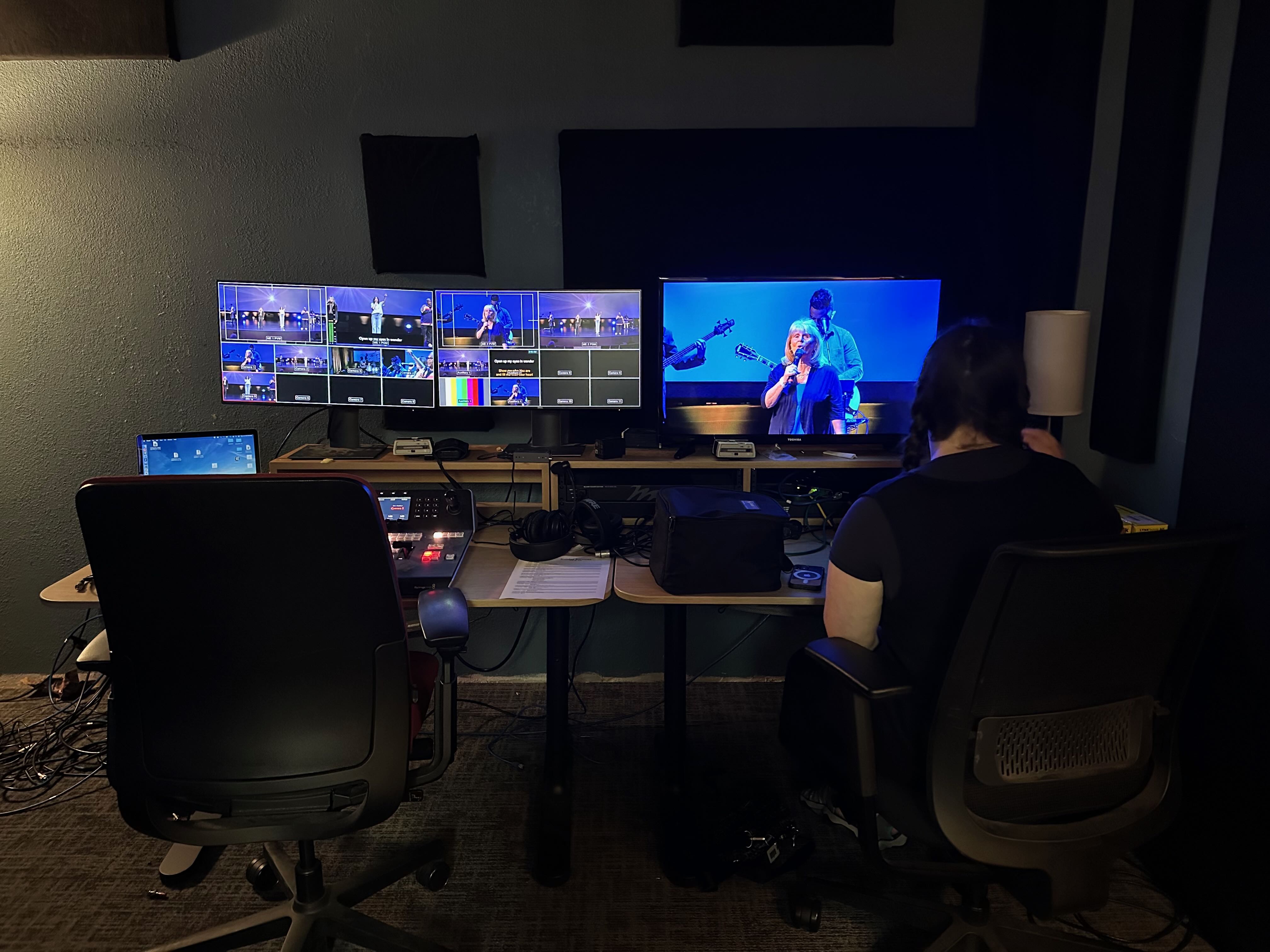
In a professional AVL integration, we often use a centralized control station. Your volunteer sits at a desk with a video switcher (like an ATEM or a Carbonite) and a PTZ controller.
- The AI Camera runs on autopilot, following the primary speaker.
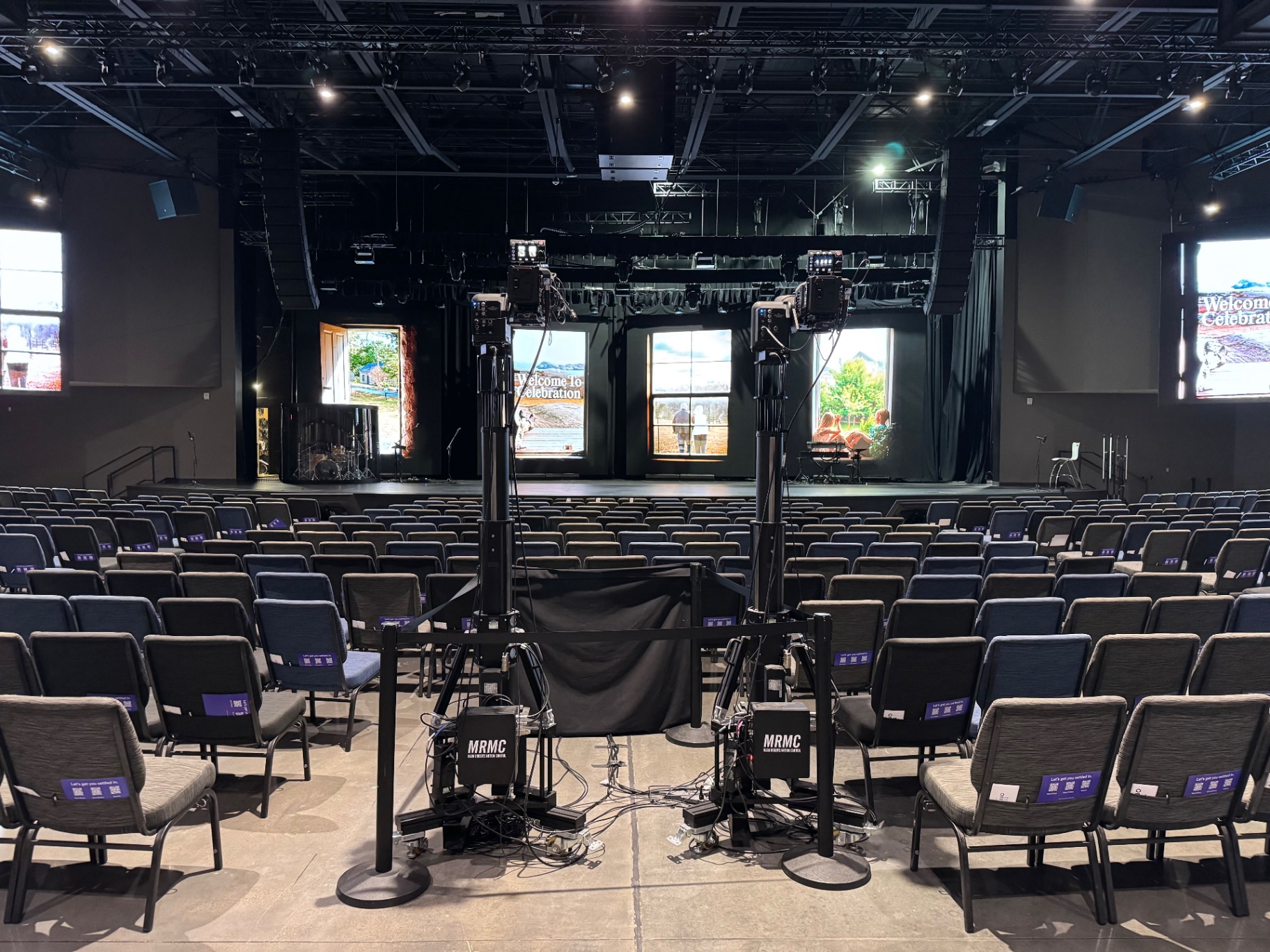
- The Standard PTZs are positioned at the sides of the room. The volunteer uses a joystick to move these cameras to find interesting shots: a close-up of a guitar solo, a shot of the congregation, or a wide angle of the baptistry.
By mixing these, your livestream feels high-energy and intentional. The AI handles the “hard” job of constant tracking, while the human volunteer handles the “creative” job of finding the best angles. This synergy keeps your production professional while significantly lowering the barrier to entry for new volunteers.
Making Life Easier for Your Volunteers
The biggest win of AI integration isn’t the technology: it’s the culture. When the technical burden is lowered, your volunteers are happier. They feel empowered rather than overwhelmed.
With 21+ years of experience in church AVL, Shepherd Multimedia understands that your volunteers are your most valuable resource. If the system is too hard to use, it won’t be used.
Here is how AI tech supports your team:
- Reduced Training Time: You don’t need to teach a volunteer how to be a professional camera operator. You only need to teach them how to monitor the AI and switch shots.
- Consistency: The AI doesn’t get distracted. It doesn’t check its phone. It doesn’t forget to follow the pastor when they walk to the edge of the stage.
- Manual Overrides: We always build in a manual override. If a volunteer wants to take control, they just grab the joystick. The AI lets go, and the human takes over. It is the best of both worlds.
Common Challenges and How to Overcome Them
No technology is perfect. AI tracking can struggle in specific scenarios:
- Complex Lighting: High-contrast lighting or heavy backlighting can sometimes confuse the sensors. We solve this by calibrating the camera’s exposure and dynamic range during installation.
- Multiple Subjects: If three people are standing close together, which one does the camera follow? We configure the system to prioritize the “center” subject or allow the operator to “lock” onto a specific person via the control interface.
- Speed of Movement: Most pastors don’t sprint across the stage, but if they move quickly, the camera needs to keep up without “jerking.” We fine-tune the motor speed to ensure the movement is cinematic and smooth.
Why Experience Matters in AVL Integration
Building a system like this isn’t just about buying the right cameras from a website. It’s about understanding the acoustics, the sightlines, and the unique workflow of your organization.
At Shepherd Multimedia Inc., we don’t just sell boxes. We design solutions. For over two decades, we have been in the trenches with churches, helping them find the right balance between “cutting edge” and “user-friendly.” We know which cameras handle low light in a sanctuary best. We know which network switches won’t drop your signal in the middle of a sermon.
We help you design a system that grows with you. Maybe you start with one AI camera and two static shots. Next year, you add a dedicated PTZ for the choir. Our goal is to ensure that every piece of gear we install serves your mission and makes your production more effective.
Take Command of Your Production
You don’t have to choose between a mediocre livestream and volunteer burnout. By integrating AI auto-tracking cameras into a multi-camera PTZ setup, you can achieve a professional, dynamic broadcast that honors your message.
Equip your team with the tools that do the heavy lifting for them. Stay ahead of the curve and ensure your venue’s uniqueness is captured in crystal-clear quality every single week.

Ready to elevate your production? Let’s talk about how a custom-designed AVL solution can transform your volunteer experience and your audience’s engagement. We partner with you to find the perfect balance for your space, your budget, and your vision.
Experience the difference that 21 years of expertise makes. Let’s build something excellent together.